When it comes to cooking and baking, few ingredients cause as much confusion as heavy cream and thickened cream. They sound similar, look nearly identical, and are often used interchangeably — but are they really the same thing? The answer depends on where you live and what you’re making.
Let’s break down everything you need to know about heavy cream vs thickened cream — from their composition, uses, and taste to how you can substitute one for the other without ruining your recipe.
Post Contents
- What Is Heavy Cream?
- What Is Thickened Cream?
- ⚖️ Heavy Cream vs Thickened Cream: Side-by-Side Comparison
- Do They Taste Different?
- How They Perform in Cooking and Baking
- Substituting One for the Other
- Are There Health or Nutritional Differences?
- Storage and Shelf Life
- Regional Naming Differences
- Which One Should You Choose?
- Final Thoughts
What Is Heavy Cream?
Heavy cream — also known as heavy whipping cream in the U.S. — is the richest type of cream you can find. It’s made by skimming the high-fat layer that naturally rises to the top of fresh milk before homogenization.
Fat Content:
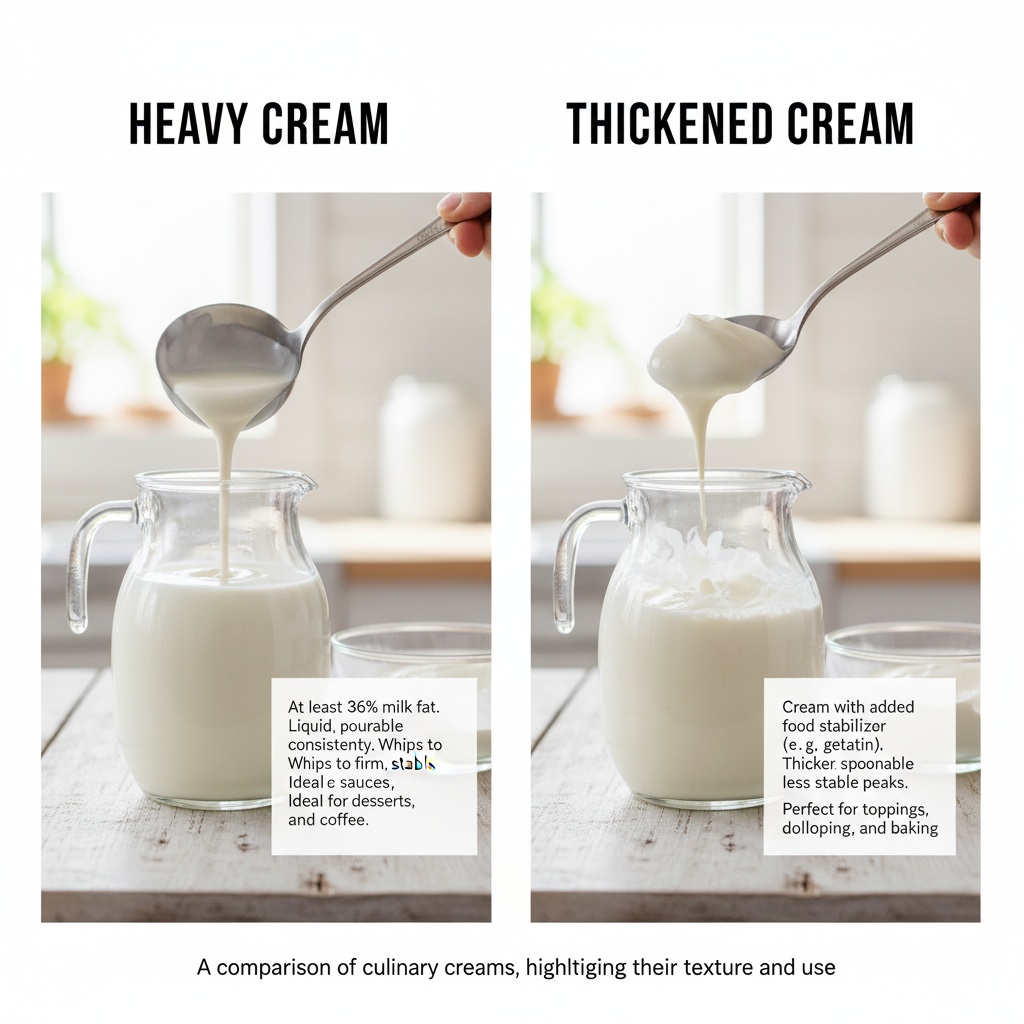
- Typically between 36% and 40% milk fat.
- Some artisanal or premium brands may even go slightly higher.
Because of its high fat content, heavy cream is thick, rich, and stable when whipped. It can double in volume, forming stiff peaks that hold their shape, making it perfect for desserts, sauces, and soups that need luxurious texture.
Common Uses:
- Whipped cream toppings
- Creamy soups (like chowders or bisques)
- Rich sauces (e.g., Alfredo or carbonara)
- Baking (custards, cakes, cheesecakes)
- Coffee or hot chocolate enrichers
Key Trait:
Heavy cream does not contain stabilizers or thickeners — its richness comes purely from fat.
What Is Thickened Cream?
Thickened cream is the term commonly used in countries like Australia, New Zealand, and the UK. While it might look and taste similar to heavy cream, there’s one main difference — it’s been slightly modified to enhance its texture and stability.
Fat Content:
- Usually between 35% and 38% milk fat, similar to heavy cream.
- However, it also contains added thickeners or stabilizers such as gelatin, carrageenan, or guar gum.
These additives make thickened cream easier to whip and help it stay firm longer, even when used in hot dishes or left standing for a while.
Common Uses:
- Whipping for desserts and pastries
- Cooking (soups, sauces, pasta)
- Serving over fruits or puddings
- General-purpose cream for recipes
Key Trait:
Thickened cream’s additives make it more foolproof in the kitchen — it’s less likely to split or curdle when heated or mixed with acidic ingredients.
⚖️ Heavy Cream vs Thickened Cream: Side-by-Side Comparison
| Feature | Heavy Cream | Thickened Cream |
|---|---|---|
| Origin/Common Use | USA, Canada | Australia, New Zealand, UK |
| Fat Content | 36–40% | 35–38% |
| Additives | None (pure cream) | Contains thickeners like gelatin or carrageenan |
| Whipping Ability | Excellent; doubles in volume | Excellent; slightly more stable when whipped |
| Texture | Naturally thick and rich | Slightly denser due to stabilizers |
| Cooking Performance | Creamy, smooth, can separate if overheated | Resists curdling or separation |
| Shelf Life | Shorter | Slightly longer (due to stabilizers) |
| Label Examples | “Heavy Cream,” “Heavy Whipping Cream” | “Thickened Cream,” “Whipping Cream” |
Do They Taste Different?
Not much. The flavor difference between heavy cream and thickened cream is subtle — both have a rich, dairy taste with a silky mouthfeel. However:
- Heavy cream has a slightly purer dairy flavor since it’s free from additives.
- Thickened cream might have a faintly gelatinous or denser texture, especially noticeable when cold or unwhipped.
For most recipes, you won’t taste a difference unless you’re eating the cream plain or in lightly flavored desserts like panna cotta or whipped toppings.
How They Perform in Cooking and Baking
1. Whipping
Both whip beautifully. Thickened cream, with its stabilizers, can be a bit more forgiving — it holds peaks longer and resists over-whipping slightly better.
Heavy cream, on the other hand, produces a fluffier, more natural whipped cream texture but can turn into butter if overbeaten.
Tip:
If you’re making whipped cream that needs to hold shape (like for cakes or pies), thickened cream might give you a longer-lasting result.
2. Sauces and Soups
Heavy cream is perfect for luxurious sauces — it enriches without overwhelming flavor. However, it can sometimes curdle if boiled or mixed with acidic ingredients (like tomatoes or lemon).
Thickened cream’s added stabilizers make it less likely to split, even under heat. That’s why it’s a favorite in professional kitchens in Australia and New Zealand.
3. Baking and Desserts
In custards, puddings, cheesecakes, or ganache, both creams perform similarly. Since most recipes rely on fat content rather than additives, you can generally substitute one for the other without major issues.
However, if a recipe specifically calls for unadulterated cream, choose heavy cream to maintain authenticity — especially in French or Italian desserts.
4. Coffee and Drinks
For coffee, hot chocolate, or milkshakes, heavy cream offers a slightly richer mouthfeel. Thickened cream might leave a faint residue or thicker consistency because of its stabilizers.
Substituting One for the Other
If you live in the U.S. and a recipe calls for thickened cream, use heavy cream instead — it will perform almost identically.
If you’re in Australia or the UK and a recipe calls for heavy cream, thickened cream is your best match.
The only time you might notice a difference is when making pure whipped cream or light sauces where texture sensitivity matters.
Substitution Ratio:
1 cup heavy cream = 1 cup thickened cream
Tip:
If you want to mimic thickened cream using heavy cream, you can whisk in a tiny pinch of gelatin (dissolved) or 1/8 teaspoon xanthan gum per cup of cream to create extra stability.
Are There Health or Nutritional Differences?
Since both contain nearly identical fat content, their nutritional values are very close.
| Nutrient (per 100ml) | Heavy Cream | Thickened Cream |
|---|---|---|
| Calories | ~350–370 kcal | ~340–360 kcal |
| Fat | 36–40 g | 35–38 g |
| Protein | 2–3 g | 2–3 g |
| Carbohydrates | 2–3 g | 3–4 g |
| Additives | None | Often gelatin, carrageenan, guar gum |
For those sensitive to gelatin (animal-based) or carrageenan (seaweed-derived), heavy cream is the purer choice. On the other hand, thickened cream’s stabilizers make it slightly easier to digest for some and longer-lasting in the fridge.
Storage and Shelf Life
- Heavy Cream:
Best kept refrigerated at or below 4°C (40°F). Use within 7–10 days after opening.
It can be frozen, but whipping quality may decrease after thawing. - Thickened Cream:
Can last slightly longer — 10–14 days after opening — thanks to stabilizers.
Freezing is possible but may cause textural separation upon thawing.
Always check for sour odor, discoloration, or curdling before use.
Regional Naming Differences
Much of the confusion comes from regional terminology:
| Country | Common Term | Equivalent |
|---|---|---|
| USA | Heavy Cream / Heavy Whipping Cream | Pure cream, no additives |
| Canada | Whipping Cream | Usually 35% fat |
| Australia | Thickened Cream | ~35% fat + stabilizers |
| UK | Double Cream | 48% fat (richer than both) |
| New Zealand | Thickened Cream / Cream | 35% fat, may have stabilizers |
So, when reading recipes from another country, check fat percentages rather than just names to find the correct match.
Which One Should You Choose?
Choose Heavy Cream if:
- You want pure, additive-free cream
- You’re making whipped cream or desserts with delicate textures
- You prefer traditional recipes
Choose Thickened Cream if:
- You need a more stable cream for cooking or piping
- You want longer shelf life
- You’re in Australia or the UK and can’t find “heavy cream” labeled products
Ultimately, both creams deliver rich, creamy flavor and texture — your choice depends more on availability and cooking context than on major differences.
Final Thoughts
At first glance, heavy cream and thickened cream seem interchangeable — and in most kitchen situations, they are. The main difference lies in the presence of stabilizers in thickened cream, which slightly affects texture and behavior in recipes.
- Heavy cream = pure cream, 36–40% fat, no additives.
- Thickened cream = nearly the same fat, but with thickeners for stability.
So whether you’re whipping up frosting, enriching pasta sauce, or topping off your coffee, you can confidently use either — just know what’s in your carton and what your recipe needs.
In short:
If you’re cooking in the U.S., heavy cream is your go-to.
If you’re in Australia or the UK, thickened cream is your everyday equivalent.
Either way, creamy perfection is only a pour away.